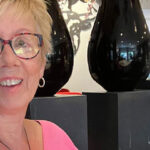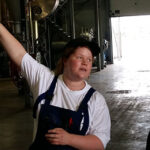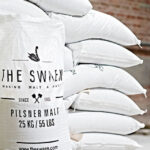
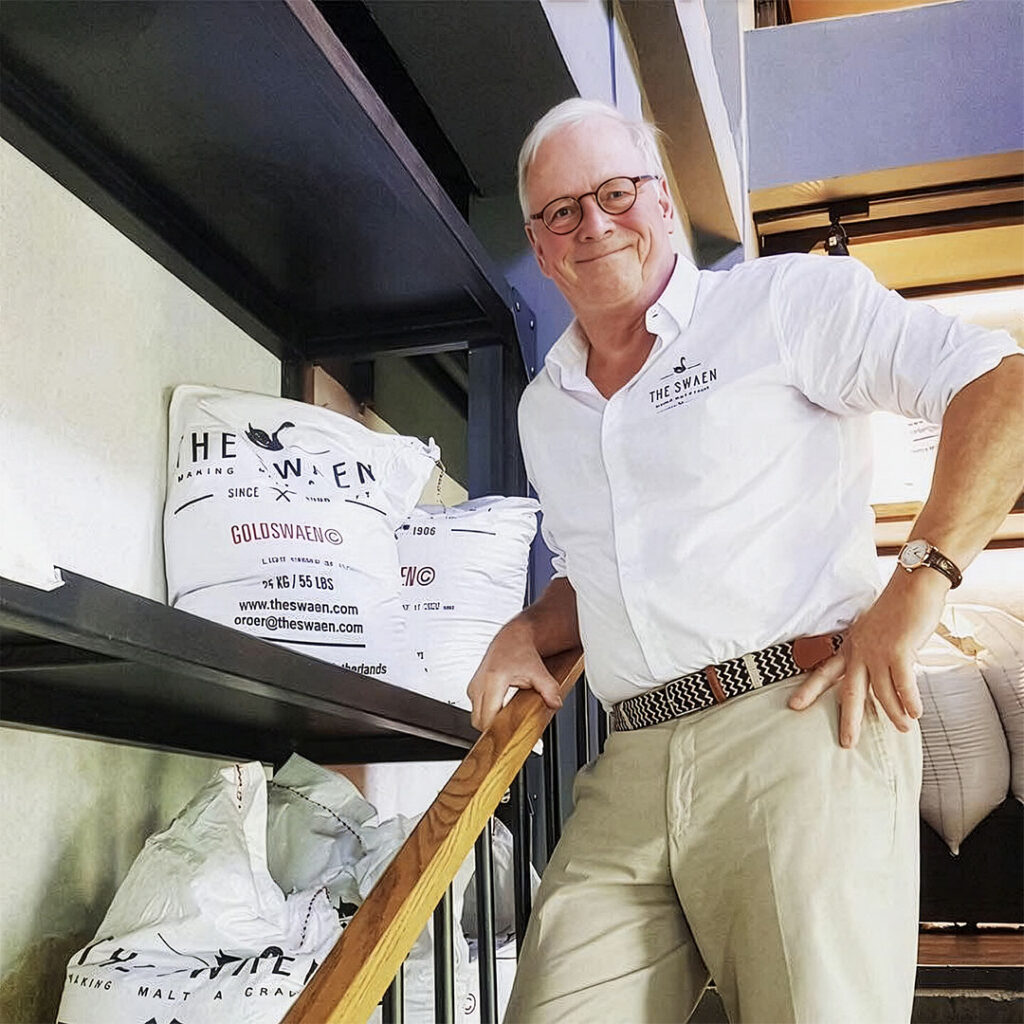
Some people have a special connection with The Swaen. That is why we went out and asked what they had to share. In a series of interviews, you get to know the company through the eyes of our employees, former colleagues, customers from past and present, distributors, and even a few legends from the industry. Andries de Groen, owner of The Swaen, certainly belongs in that last category. This is Celebrating The Swaen with Andries de Groen.
When did you first hear about The Swaen?
That was a very long time ago. Back then, the company was still called Mouterij Menu. They were a supplier to Grolsch Brewery, where I took over management in 1985. That relationship already existed when my father was in charge.
Do you remember your first day at The Swaen?
I studied at the brewing school in Ghent. As a third-year student, your first work visit was to the malthouse here in Kloosterzande. So my first visit dates back to 1977. Jan Menu gave us a great tour, and we learned a lot about malt. There was still an old-fashioned bar at the time, where everything was discussed in a cosy setting. If I’m not mistaken, there is still a sticker from our student association on one of the wooden beams.
How would you describe The Swaen in one sentence?
The Swaen has always been incredibly driven by quality. That sense of quality really runs through the entire company.
How would you describe the culture in one sentence?
It is almost family-like. A group of people who feel they are in it together and want to get the very best out of it. That probably has something to do with the Zeeland culture. Perhaps similar to where I come from – noaberschap, how you treat each other. That is still strongly valued here, in a positive way. And you can see that on the floor, both in the office and in the malthouse.
Which moment has stayed with you the most?
When we, as Grolsch, took over the malthouse out of bankruptcy. That was a collaboration with the then director, Jos Haak, a good friend and fellow student. It was a very special moment. The malthouse had been idle for some time, but it quite literally came back to life.
And then the moment when we first started working with specialty malts. The early days with the roaster were a major technical challenge. And when you finally see those beautiful roasted black malts or golden caramel malts coming out… yes, those are truly special moments.
What is The Swaen’s greatest strength?
I would say its innovative character. How do we make sure that what we produce is really good? The Swaen is small, which means you are fairly flexible. And of course, the people. They like things to run smoothly and routinely, but they also understand that sometimes things have to change. A lot of great developments have taken place in both products and processes.
What is the most important evolution you have experienced?
The most important evolution is the move from a pilsner malthouse to a specialty malthouse. That required a complete shift in mindset. Before that, the malthouse supplied exclusively to Grolsch. Everything went there, and it was all about pilsner malt. The entire malthouse was designed to produce one product, without any frills. And then, suddenly, specialty malt had to be added. That was a huge change. We went from one customer to hundreds of customers. We really had to start all over again.
What sets The Swaen apart from other malthouses?
I genuinely believe that we are technically the very best in the world. We have truly made a difference there. While others continued with existing techniques, we had to build a completely new specialty malthouse in one go. Naturally, we immediately chose the very latest technology available.
Which moment made you proud to work here?
That we managed to build something from nothing twice. The first time was the takeover after the bankruptcy. I am proud that we made that work. The second time was when we grew from a pilsner malthouse into a specialty malthouse.
Which period was the most challenging, and why?
That again brings me back to the specialty malthouse. We took over the pilsner malthouse from Grolsch. There were no customers yet, and we immediately made major investments. That transition was an exciting period. Step by step, we had to travel the world, but we always had a consistent story. One I still believe in today.
What do you think is crucial to remain relevant as a malthouse?
You have to stay slightly ahead. But you must not get too far ahead of the troops, because then you lose them. Important things are happening in the world. Alcohol consumption is declining. That does not automatically mean malt consumption will drop, because alcohol-free drinks can also contain malt. But as a malthouse, you do need to respond to these changes. The production of distilling malt is decreasing because less whisky is being consumed. At the same time, other drinks are becoming more popular, and we need to anticipate that. We have to stay just far enough ahead to keep up, because if you fall behind, you might miss the train.
What advice would you give to new colleagues?
Listen carefully to what your colleagues have to say, because they have built up a great deal of experience. They know all the ins and outs, and that matters. We are a new malthouse, but at the same time also an old one, each with its own quirks. And above all, stay true to yourself. If you have ideas on how things can be improved, talk about them.
Where do you see The Swaen in ten years’ time?
We will certainly still play an important role in the beer world. But by then, we will also have entered other segments. The knowledge we have of products and processes, such as roasting, can also be applied in other sectors. So in ten years’ time, the malthouse will be more diverse than it is today.
From nearly going bankrupt to becoming one of the world’s most technically advanced specialty malt producers – Andries de Groen shares the story behind 120 years of craftsmanship, innovation and Dutch spirit. Read more stories or get in touch – we’d love to hear from you.