
A Certificate of Analysis arrives with every bag of malt. Most brewers glance at extract, check the colour, and move on. They are leaving most of the information on the table. A COA is not a marketing document. It is the laboratory record measured against the parameters that decide how the malt will mash, how it will lauter, what your beer will taste like, and how it will age. That is why reading a malt COA is key.
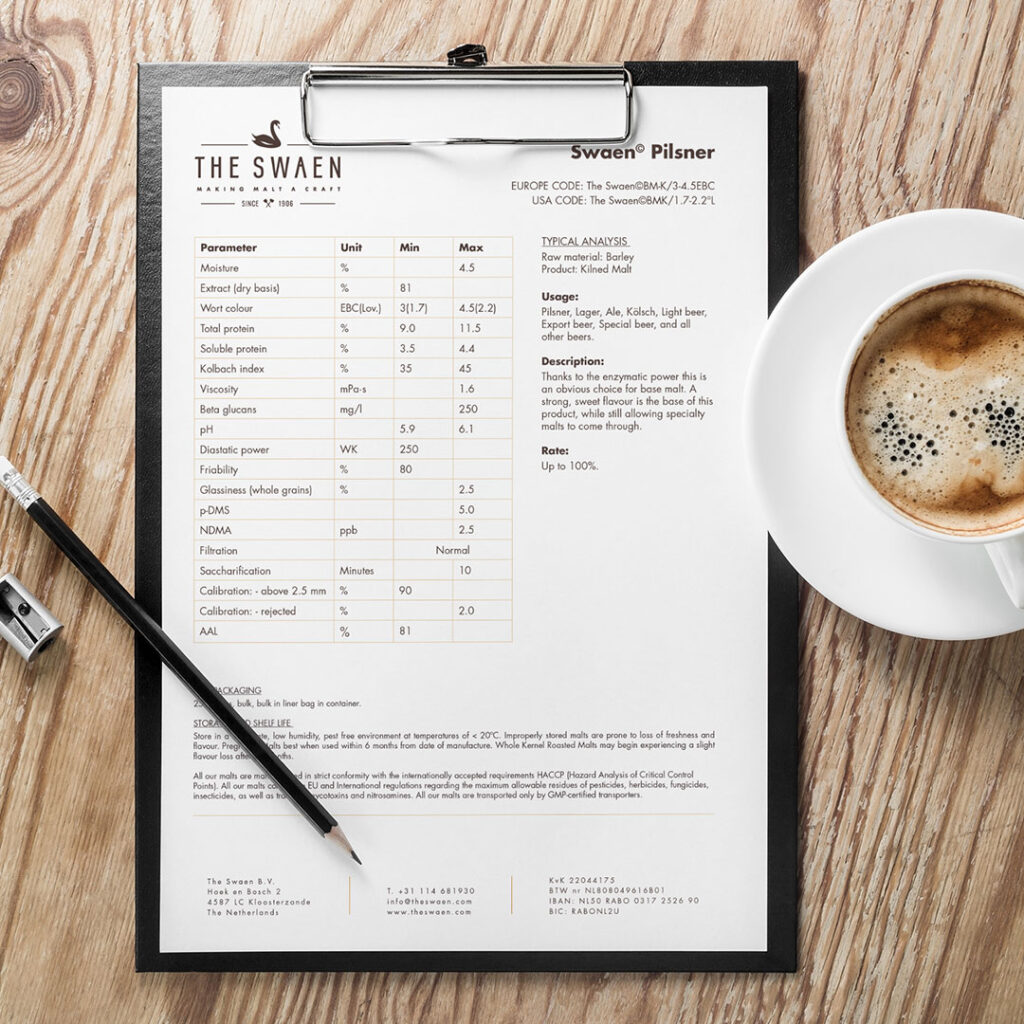
Read properly, it tells the brewer almost everything they need to know to set up a successful brew day. Read carelessly, it tells them only that the bag is roughly within the supplier’s typical range. The spec sheet does tell a substantial part of the story, and a brewer who knows how to read it has an advantage every other brewer in the room is leaving unused.
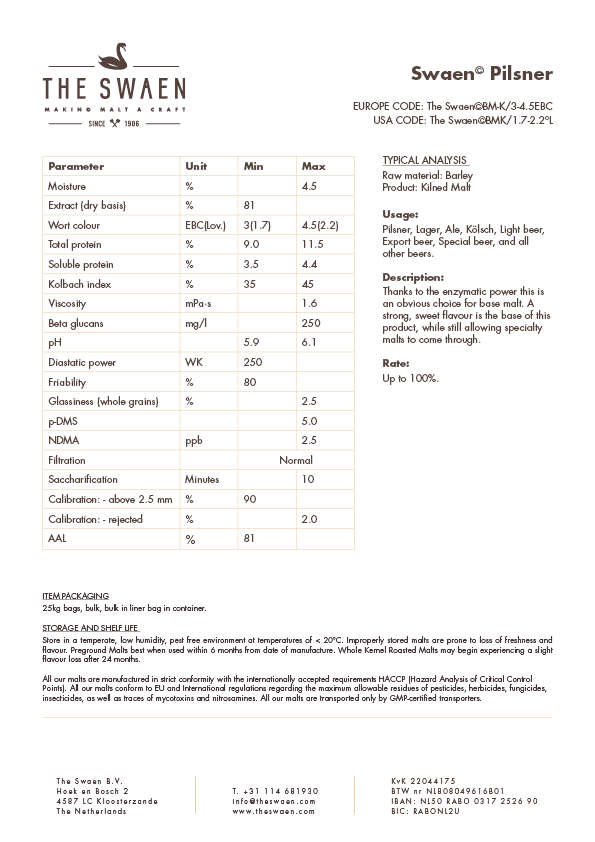
Below is a walk through a real Swaen© Pilsner COA, organised by what the brewer is actually trying to learn – not by the order the numbers happen to appear on the page.
Typical COA versus Actual COA – why they are not the same
Before going into the numbers, the distinction is worth making. Inside our malthouse, we talk about two kinds of COA – the Typical COA and the Actual COA. Both are real certificates of analysis. They simply answer different questions.
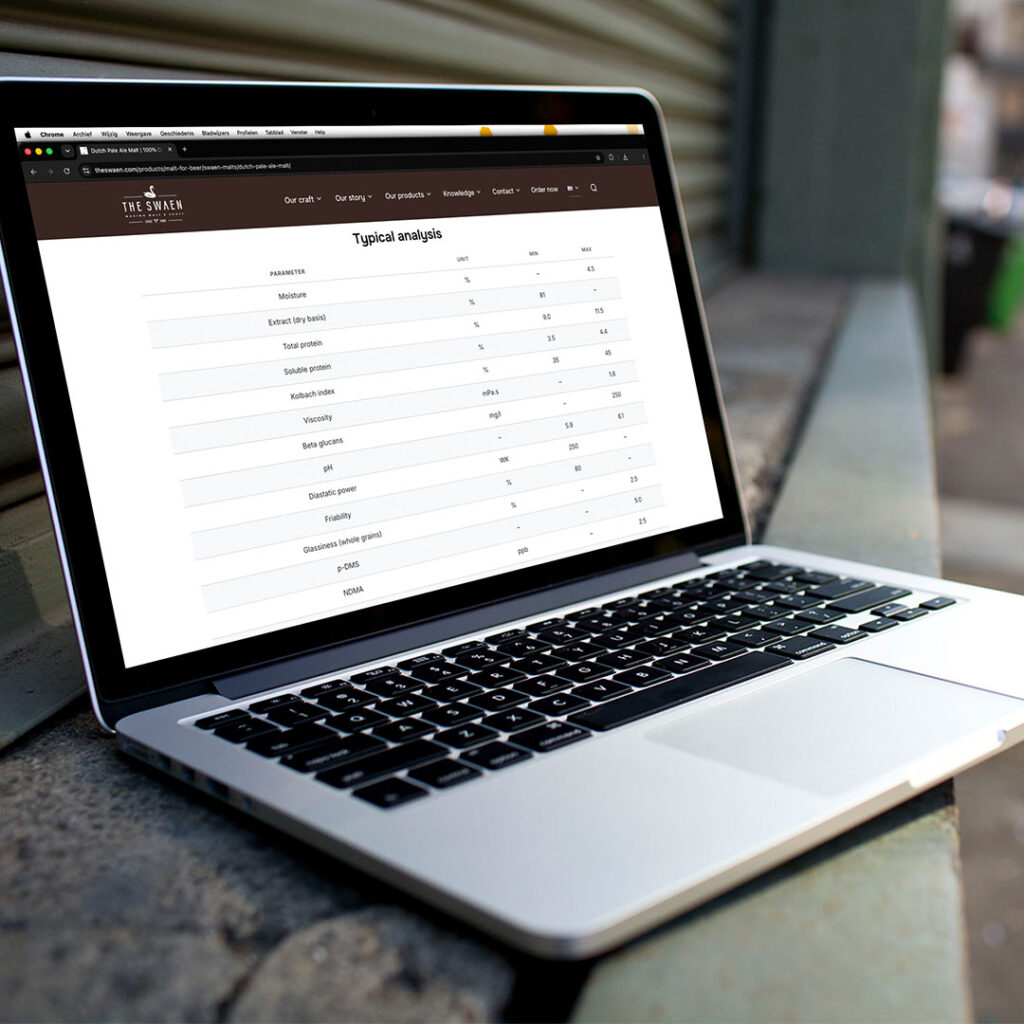
The Typical COA is the published specification range for a malt across all batches. It is what you will find on our website and inside our brochure. Useful for selecting a malt, comparing suppliers, or pricing a recipe – but not specific to the bag in front of you. The Swaen© Pilsner Typical COA, for instance, gives a maximum moisture of 4.5%, an extract minimum of 81% on dry basis, a colour of 3–4.5 EBC, minimum diastatic power of 250 WK, and so on.
The Actual COA is the laboratory result for one specific batch – the lot number printed on the bag the brewer just received. Same product, different bag, slightly different numbers. Barley is an agricultural product, and even the best maltster cannot deliver perfect repeatability from harvest to harvest, region to region, season to season. The Actual COA is the bag-by-bag record of where this particular lot landed inside the published Typical range.
The brewing decisions worth making depend on the Actual COA, not the Typical. The Typical tells the brewer what to expect; the Actual tells the brewer what they have. Both are needed – the Typical to decide the recipe, the Actual to brew it.
What you can expect to brew – extract, attenuation, enzymes
Extract, dry basis – minimum 81%
The headline yield figure. It is the percentage of soluble material a fully-modified, finely-milled sample will release under controlled lab conditions. Real-world brewhouse extract will always be lower – the mill is coarser, the mash is less ideal, the lauter is imperfect – but the COA’s fine-grind extract sets the ceiling for what is achievable. A drop of 0.5–1% on the COA from one batch to the next is significant enough to recalculate the grain bill.
Apparent Attenuation Limit (AAL) – minimum 81%
AAL measures the maximum fermentable fraction of the wort under standardised lab conditions. An 81% AAL means in principle up to 81% of the extract can be fermented; the rest remains as unfermentable dextrins and residual sugars contributing body. This figure tells the brewer the lowest practical final gravity. A craft Pilsner aiming for a dry, crisp finish wants this number high; a sweeter style might prefer a lower AAL.
Diastatic Power – minimum 250 WK
The activity of the enzymes – primarily alpha-amylase and beta-amylase – that convert starch into fermentable and non-fermentable sugars during mashing. 250 WK (Windisch-Kolbach) is high. For an all-malt grist this is more than enough; for a grist with significant unmalted adjuncts (maize, rice, raw wheat or barley), enzyme reserve at this level allows the base malt to convert the adjunct starch as well as its own.
Saccharification time – maximum 10 minutes
The lab measurement of how long it takes the malt’s enzymes to fully convert starch to sugars in a standard mash. Ten minutes is fast and indicates strong enzyme activity. In the brewhouse, this translates to predictable mash conversion and the freedom to run shorter rests when recipe design calls for it.
How well the malt is modified – the cytolysis and proteolysis numbers
Modification – the breakdown of cell walls (cytolysis) and proteins (proteolysis) inside the kernel during germination – is the maltster’s craft. A well-modified malt mashes cleanly, lauters predictably, and gives consistent extract. The COA reports modification through several complementary measurements; together they tell the brewer how thoroughly the malting did its job.
Friability – minimum 80%
A friabilimeter rubs malt against a rotating rubber drum and measures the percentage that crumbles. Well-modified kernels crumble; under-modified ones resist. Above 80% indicates good modification; above 85% is excellent. If friability drops noticeably batch-to-batch, the mill gap may need to be reset to grind more finely.
Glassiness (whole grains) – maximum 2.5%
The reverse of friability – the percentage of kernels that remain hard and translucent rather than crumbly. Above 5% suggests significant under-modification and predicts brewhouse problems: slower runoff, lower extract, residual starch in the spent grain.
Calibration – minimum 90% above 2.5 mm, maximum 2% rejected
Calibration measures kernel size distribution on a sieve. Plump, large kernels carry more starch and more enzyme; thin kernels carry less. A 90% minimum above 2.5 mm is a strong quality benchmark. The 2% rejected number is the small or broken kernel fraction that contributes little extract.
Kolbach Index (Soluble Nitrogen Ratio) – 35–45%
Sometimes written as S/T Ratio. The percentage of total protein that has been broken down into soluble protein during germination. A Pilsner malt sits at the lower end of this range – typically 35–42% – because Pilsner brewing prefers a lighter protein profile for clean flavour and bright clarity. Higher Kolbach (above 45%) suggests the protein has been broken down too far, risking head retention.

How the malt will behave in the brewhouse
Viscosity – maximum 1.6 mPa·s
Wort viscosity measured in the lab. High viscosity slows lauter runoff and indicates residual beta-glucan or large protein fragments still in solution. Below 1.6 is good and predicts a predictable runoff.
Beta-glucans – maximum 250 mg/L
Beta-glucans are the gummy cell-wall compounds that, if not broken down during malting, end up in the wort and cause slow runoff, chill haze, and a thinner-than-expected mouthfeel. 250 mg/L is the upper bound; well-modified Pilsner malt typically runs well under 200. Higher than 250 and the brewer should expect a longer lauter and check wort viscosity in the mash tun.
Total Protein – 9.0–11.5%
The total amount of protein in the malt. Higher protein means lower extract, more potential for haze, but also better foam and body. The tight 9.0–11.5% band on Swaen© Pilsner is what makes the malt consistent across batches – and what allows recipes built on this base to behave predictably year-round.
Soluble Protein – 3.5–4.4%
The fraction of protein that has been broken into water-soluble forms during germination. This is what feeds the yeast and contributes to head retention. Too low and yeast nutrition suffers; too high and the beer develops haze and stability problems.
pH – 5.9–6.1
Malt pH affects mash pH, which affects enzyme activity, extract, and the perceived crispness of the finished beer. A narrow band like 5.9–6.1 means the brewer can build a consistent water treatment recipe and not have it derailed by a different lot.
Filtration – Normal
A categorical descriptor, not a number. “Normal” filtration behaviour means the malt is expected to lauter and filter at standard rates, without surprises.
What the beer will taste and look like
Wort colour – 3–4.5 EBC (1.7–2.2 Lovibond)
The colour of the standard Congress wort produced from the malt. For a 100% Pilsner-malt grist, this is roughly the colour of the unboiled wort; the finished beer will be a touch darker after boil and maturation. A tight EBC range like this is the foundation of a brewery’s batch-to-batch colour consistency.
p-DMS – maximum 5.0 mg/kg
The precursor to dimethyl sulfide – the compound responsible for the cooked-corn off-flavour that haunts under-boiled pale lagers. Properly kilned Pilsner malt drives off most of the SMM precursor during kilning; what remains as p-DMS in the finished malt is what the brewer’s boil has to handle. A maximum of 5.0 mg/kg is conservative and tells the brewer that a standard 60–90 minute boil will manage DMS without trouble.
Quality and safety markers
Moisture – maximum 4.5%
Higher moisture risks mould, reduces brewhouse yield per kilogram of grain, and shortens shelf life. Lower than 3% and the husks shatter during milling, generating dust. The 4.5% maximum is standard for European Pilsner malt and gives a healthy shelf life under proper storage.
NDMA – maximum 2.5 ppb
N-nitrosodimethylamine, a trace contaminant from the kilning process. A figure this low signals an indirect-fired, well-controlled kiln. NDMA is regulated under EU food safety law; the 2.5 ppb maximum is conservative against the regulatory threshold.
A short reference card
For brewers who want a single page to print and stick on the wall, the Swaen© Pilsner Typical COA ranges and the Actual COA flags worth watching:
| Metric | Healthy | Watch when |
| Extract, dry basis | ≥ 81% | Drops 0.5–1% batch-to-batch |
| Apparent Attenuation Limit (AAL) | ≥ 81% | Significantly higher or lower than recipe is tuned for |
| Diastatic Power | ≥ 250 WK | Below 200 with adjunct-heavy grist |
| Saccharification | ≤ 10 min | Climbs above 15 min |
| Friability | ≥ 80% | Drops below 80% – adjust mill gap |
| Glassiness | ≤ 2.5% | Above 5% – expect runoff and extract issues |
| Calibration above 2.5 mm | ≥ 90% | Falls below 85% |
| Kolbach Index | 35–45% (Pilsner) | Below 35% – head retention; above 45% – clarity |
| Viscosity | ≤ 1.6 mPa·s | Above 1.7 – expect slow runoff |
| Beta-glucans | ≤ 250 mg/L | Above 250 – long lauter, chill haze risk |
| Total Protein | 9.0–11.5% | Above 12% – haze and lower extract |
| Soluble Protein | 3.5–4.4% (1,.7–2.2 °L) | Below 3.5% – yeast nutrition; above 4.4% – stability |
| pH | 5.9–6.1 | Outside band – water treatment needs reset |
| Wort Colour | 3–4.5 EBC | Outside band – recalculate colour |
| p-DMS | ≤ 5.0 mg/kg | Above 5 — extend boil |
| Moisture | ≤ 4.5% | Above — storage and yield risk |
| NDMA | ≤ 2.5 ppb | Above — flag to maltster |
How brewers actually use a COA
The metrics above are not equally important on every brew day. A few habits help a brewer turn the page from “read” to “used”:
When planning a new recipe, the Typical COA is the starting point – extract, AAL, Diastatic Power, and Total Protein set yield, attenuation, and grain-bill proportions.
When commissioning a new batch on a regular recipe, the Actual COA matters most. The friability, Kolbach, beta-glucan, and viscosity on this specific lot tell you whether mash and lauter behaviour will match the previous batch. If they have shifted significantly from the previous lot, adjust mill gap, mash temperature, or runoff rate before brew day – not during.
When troubleshooting, the Actual COA tells you whether a problem is in the malt or in the brewhouse. A slow runoff combined with elevated beta-glucan on the Actual COA points to the malt; a slow runoff with normal beta-glucan points to milling, mash temperature, or lauter design.
When comparing suppliers, both COAs matter. The Typical COA tells you the supplier’s published commitment; the Actual COA tells you how often they hit it. Two malts with the same nominal extract on their Typical COAs can show very different real-batch behaviour on their Actuals – and that difference shows up in your beer.
The COA is a starting point, not a finish line
Every Swaen© Actual COA is the result of a full lab work-up – moisture, extract, modification, protein, enzymes, colour, beta-glucan, viscosity, calibration, food-safety markers – all measured on every batch before it leaves the malthouse. We supply the result not as a marketing claim but because the brewer using the bag deserves to know exactly what they are working with.
The numbers tell most of the story. The sensory work – the taste, the aroma, the way the wort runs in the brewhouse – tells the rest. Both matter. A brewer who reads the Actual COA in front of the bag, instead of after the problem, has learned to use the most accurate piece of information a maltster can produce. The bag is on the floor. The COA is on the desk. Reading the second is what makes the most of the first.
Curious how these values line up for a specific malt in our range? You can download the Typical Analysis for all products.