Every barley crop behaves a little differently. Weather during grain filling and ripening can influence how the starch in barley develops and, ultimately, how the malt behaves in the brewhouse. After the particularly challenging 2023/24 crop, many brewers are asking what to expect from the new crop and its gelatinisation temperatures.
Importantly, starch gelatinisation characteristics are largely determined during barley growth. The maltster cannot adjust the gelatinisation temperature during malting. The good news is that 2026 is not a repeat of 2024. Gelatinisation temperatures are still somewhat elevated, but the current crop remains manageable for brewers. There are simply a few points worth keeping in mind when setting your mash temperature.
What are we seeing in the 2026 crop?
Our preliminary analysis of the new crop shows:
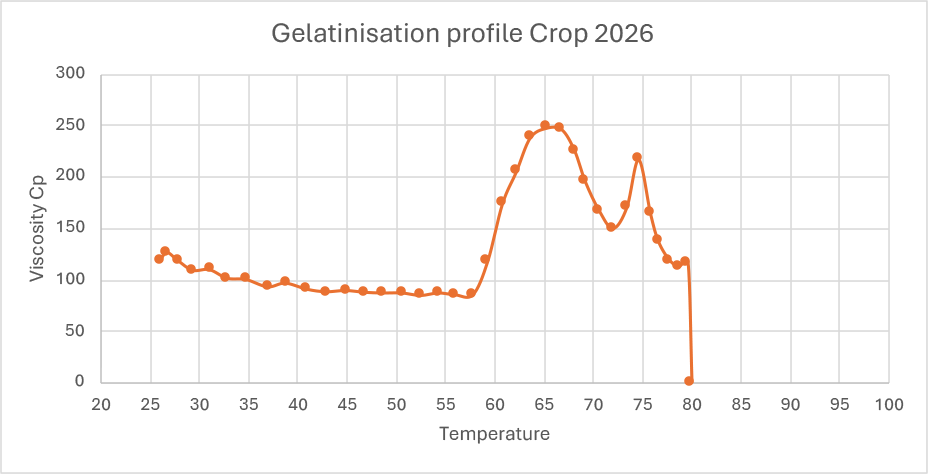
- Gelatinisation starts: around 59°C
- First major peak: around 65°C
- Second substantial peak: around 74°C
The first peak is close to the temperature where brewers normally conduct their main saccharification rest. The second peak at around 74°C is worth paying attention to. These are preliminary results, and we will continue testing in the coming period to see whether there are significant differences between barley varieties and growing regions.
Why does gelatinisation temperature matter?
Starch needs to gelatinise before malt enzymes can break it down. At around 65°C, where we see the first major gelatinisation peak, β-amylase is highly active and produces the fermentable sugar maltose. α-amylase is slightly active but becomes increasingly important as temperatures rise. At around 74°C, β-amylase activity is close to zero, while α-amylase remains active.
This means there is an important relationship between starch gelatinisation and enzyme activity. Ideally, we want the enzymes to work on all gelatinised starch while β-amylase is still highly active. We can then raise the temperature to make the remaining, higher-gelatinisation starch accessible. But that means you compromise on β-amylase activity.
In this case the higher gelatinisation temperature itself is therefore not necessarily a problem. The important question is whether the starch becomes accessible while sufficient enzyme activity remains.
The two main conversion enzymes
Gelatinisation temperatures are a fundamental part of brewing science. They define when starch becomes available and set the stage for efficient conversion. By understanding and applying this concept, you can improve extract efficiency, optimise your mash, and produce more consistent beer. Whether you are brewing a simple lager or a complex adjunct-heavy recipe, controlling gelatinisation is key to getting the best out of your ingredients.
| Enzyme | Main role | Optimum in mash | Significant loss of activity |
| β-amylase | Produces maltose and other fermentable sugars. | ~60–65°C | Increasingly above ~65–70°C. |
| α-amylase | Breaks starch into smaller dextrins and substrates for β-amylase. | ~70–75°C | Increasingly above ~75–80°C. |
These temperatures are indicative rather than absolute. Enzyme stability also depends on other factors such as: pH, mash thickness, mash salts. Important to notice is that β-amylase is considerably more heat-sensitive than α-amylase. That is why the 74°C gelatinisation peak deserves some attention.
What should brewers do?
Two-step mash
For most small breweries, there is no need to make major changes. A simple two-step mash is enough to deal with the 2026 profile. If your brewhouse allows this, we recommend: 65°C main conversion rest → 74°C secondary rest → 78–80°C mash-out.
The first rest allows the enzymes to work while the main starch fraction gelatinises. The second rest around 74°C helps the remaining higher-gelatinisation starch become accessible. At this temperature, α-amylase remains active and can continue breaking down the newly gelatinised starch. You don’t need a complicated historical decoction schedule. A straightforward two-step mash is sufficient.
What if you use a single infusion?
Single-infusion brewing is slightly more challenging. You want to choose a temperature that provides good β-amylase activity while also allowing the majority of the starch to gelatinise. For a 100% Pilsner malt brew, we recommend: Mash in at 64–65°C and hold the mash there for your normal conversion rest.
This gives β-amylase plenty of time to work while the main gelatinisation peak is around 65°C. If your brewery normally mashes at 67–68°C, consider lowering the mash temperature slightly for the 2026 crop rather than increasing it. Importantly, don’t go too low simply to protect β-amylase. A mash-in around 62–63°C may preserve enzyme activity, but it does not address the underlying issue: the starch needs to gelatinise before the enzymes can efficiently access it.
For 2026 malt, around 65°C is a good starting point. The limitation of a single infusion is that you cannot fully address the second gelatinisation peak around 74°C without moving into a temperature range where β-amylase activity has already declined substantially. If you need to maximise conversion and fermentability, a simple second rest around 74°C gives you more control.

Keep it simple – and check your conversion
The 2026 crop is not a reason to change your entire brewing process, just cross-check your mashing parameters. We recommend to start with 64–65°C for the main rest. If your system allows it, add a ~74°C secondary rest before mash-out. And, as always, let the wort tell you what is happening. A quick iodine test can confirm whether starch conversion is complete. Brewhouse efficiency and wort fermentability are also useful indicators.
The 2026 crop has a few points of attention, but it is perfectly manageable. Don’t panic. Understand the malt, adjust where necessary, and keep brewing.
Happy brewing!
Wouter de Sutter
Questions about your 2026 malt or mash schedule? Ask Wouter.